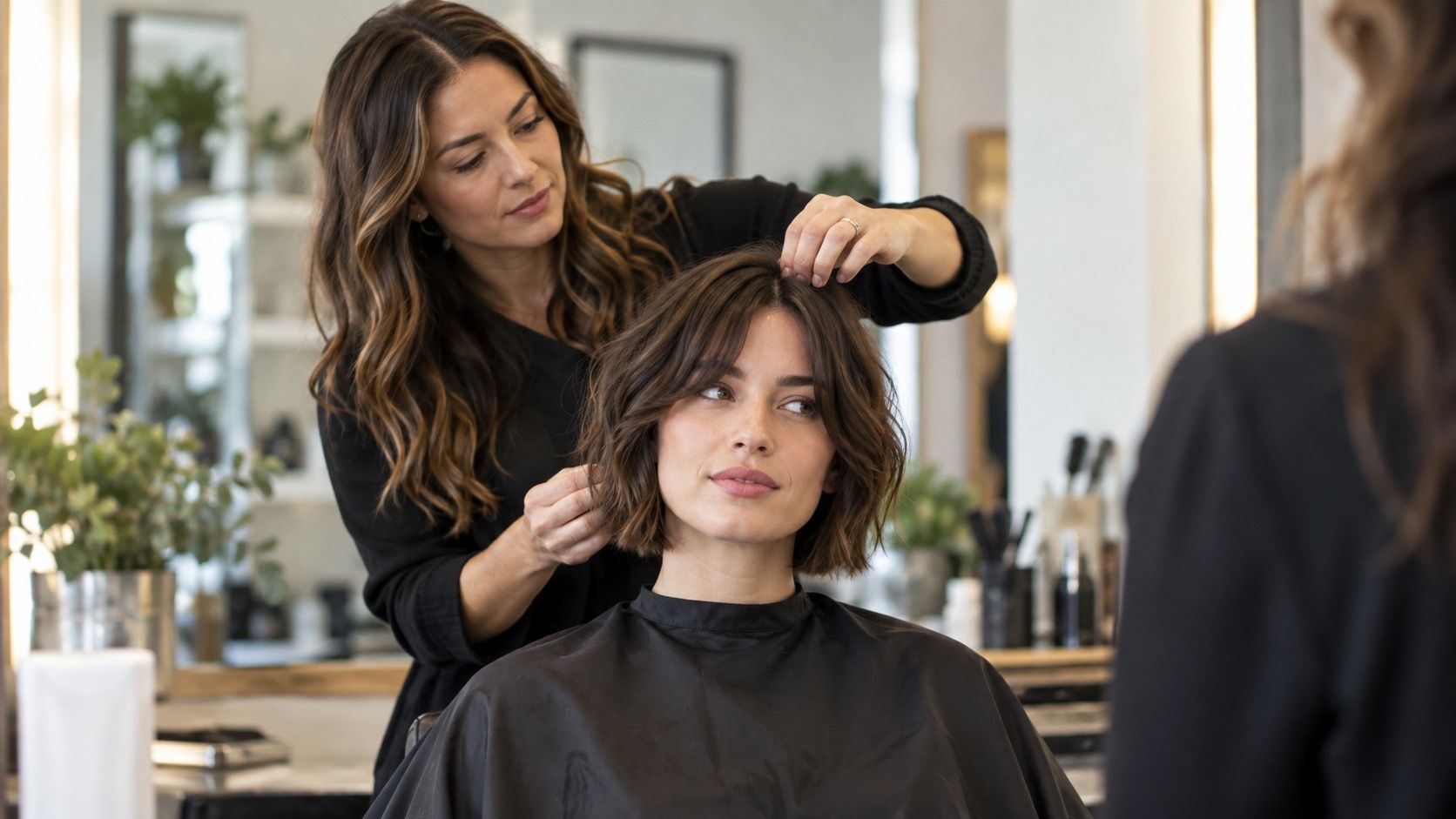
A square face shape is usually recognized by similar widths across the forehead, cheekbones, and jaw, paired with a jawline that has visible structure. The chin may be broad, softly squared, or only slightly rounded; a sharp chin is not required. The key is the overall balance of the upper and lower face, not a single dramatic angle.
What square face shape describes
Many faces have a strong jaw without being square. A face can be long enough to read rectangle, or it can taper enough through the lower face to read oval with angular features. To recognize square face characteristics, compare the full outline from forehead to chin and ask whether the sides remain relatively even in width.
A square face shape is usually recognized by similar widths across the forehead, cheekbones, and jaw, paired with a jawline that has visible structure. The chin may be broad, softly squared, or only slightly rounded; a sharp chin is not required. The key is the overall balance of the upper and lower face, not a single dramatic angle.
Use a front-facing comparison
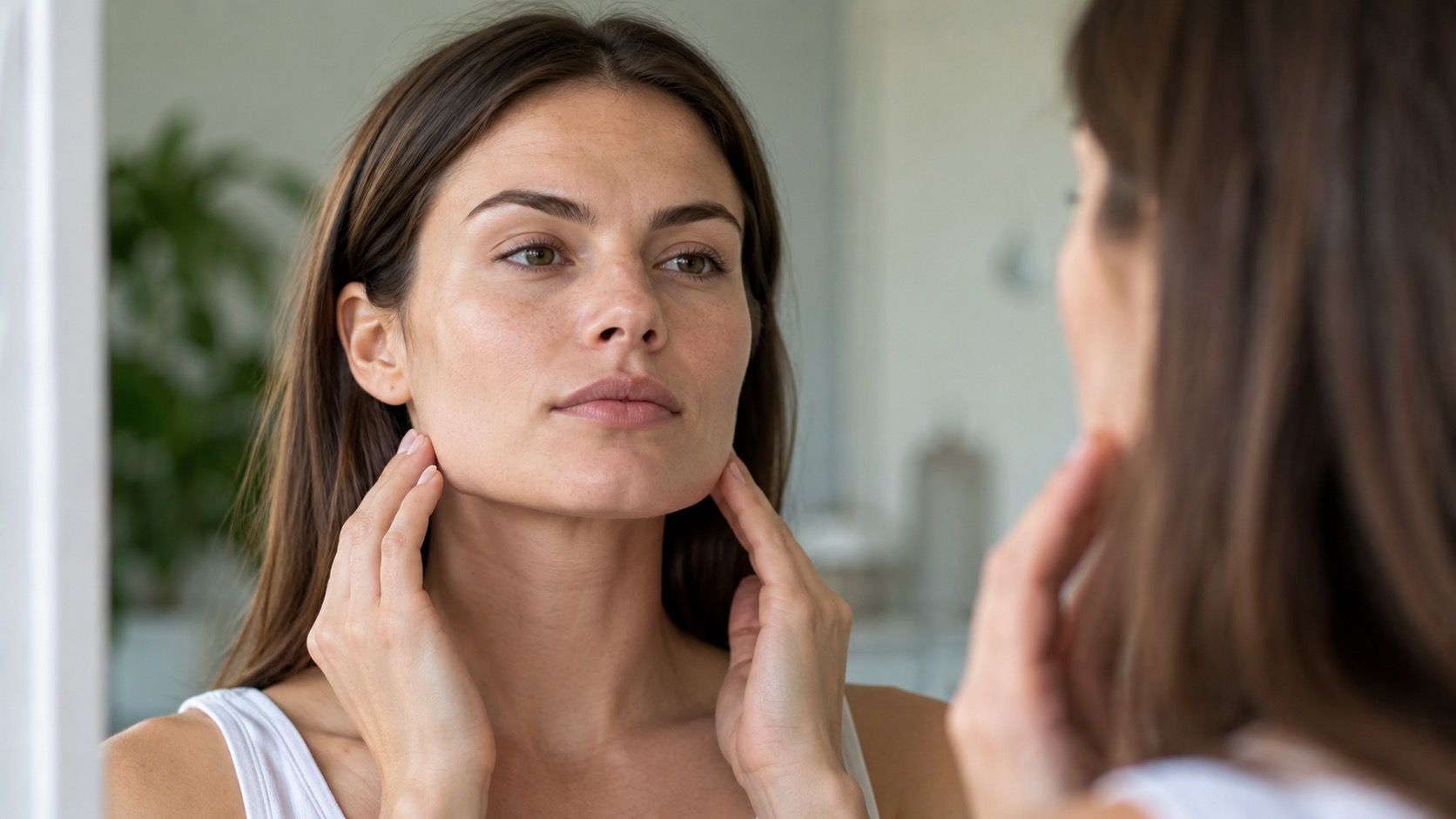
Pull hair away from the temples and jaw, then look in even light with your head level. A neutral expression matters because clenching the teeth makes the lower jaw appear wider, while a wide smile can hide its corners. A photo taken at eye height from a little distance gives a useful second view. Close lenses can broaden the center of the face and make any jaw appear less proportionate.
Trace the outline mentally rather than drawing a harsh box over it. Notice where the forehead reaches its width, where the cheekbones sit, and where the jaw turns upward toward the ears. On a square face, the jaw often holds its width farther toward the chin than on an oval or heart-shaped face. The corners may be subtle; they do not need to look geometric.
Compare forehead, cheekbones, and jawline
Start with the broadest part of the forehead, then measure or estimate across the cheekbones and between the jaw angles. Square proportions often show these widths as fairly close. A small difference is ordinary; the comparison is qualitative. If the cheekbones are dramatically wider than both forehead and jaw, another shape may describe the face better.
Face length is the next check. When the face is substantially longer than it is wide but still has similar horizontal widths and a firm jaw, rectangle or oblong may be a more precise description. When length and width feel closer, square characteristics become more likely. Use a flexible tape if the mirror is uncertain, but do not treat a few millimeters as a verdict.
| Observation | Useful interpretation |
|---|---|
| Length is clearly greater than width | Compare oval or rectangle traits before choosing a label. |
| Cheekbones lead the horizontal widths | Check whether the jaw tapers softly or stays broad. |
| Jaw corners are visible | Look at overall length to separate square and rectangle proportions. |
| Two labels seem plausible | Keep the repeated traits instead of forcing a perfect category. |
Tell square from rectangle and round
Square and rectangle faces share a strong jawline and comparable widths. Rectangle faces add more vertical length, so the outline looks longer even when the jaw has clear corners. Compare a straight photo rather than a tilted one; lowering the chin can compress length and make a rectangle look square.
Round faces can be similarly wide, but their lower contour is softer. The difference is not whether the jaw is “good” or “bad”; it is simply whether the line beneath the cheeks turns gradually or holds a more defined horizontal direction. If your features combine a broad jaw with soft cheeks, a square-round description may be more accurate than insisting on one label.
Apply the observation to personal style
Square face style advice often says to soften everything. That is a preference, not a rule. Rounded frames, textured layers, and curved earrings can create contrast if you enjoy it. Angular frames, blunt cuts, and structured collars can also look striking when you want to echo the jawline. Decide whether you want harmony, contrast, or neither before treating a chart as instruction.
Practical details still come first. Glasses need a comfortable bridge and temple fit. Haircuts need to work with your natural density and the time you want to spend styling. Makeup placement should be comfortable for your skin and routine. Face shape adds a reference point, but it cannot replace trying something on in real light.
Keep a precise but relaxed description
A useful note might say: “my forehead and jaw are similar in width, my face is not much longer than it is wide, and my jaw has visible corners.” That says more than simply declaring “square.” It also leaves space for changes in hairstyle, expression, and the angle of a photograph.
Asymmetry is normal. One jaw corner may appear stronger, or the hairline may be wider on one side. Look for the pattern that repeats across several ordinary views. The purpose of recognizing a square face shape is to understand proportion, not to reduce a living face to a diagram.
Check the outline without exaggerating it
Square face characteristics are easiest to see when the jaw is relaxed. Some people test by tightening their teeth or sucking in the cheeks, which creates a more severe outline than their ordinary face has. Instead, take a straight photo in soft light and compare the forehead, cheekbones, and jaw at rest. If the lower face keeps its width and the jaw corners remain noticeable, the observation is likely meaningful.
That observation can coexist with softness. A square face may have rounded cheeks, a gentle chin, or an uneven hairline. Describe what you see rather than trying to make every feature match a diagram. A detailed description is more useful for real styling decisions and usually feels kinder as well. Compare both sides of the face without expecting them to match exactly. The goal is the broad silhouette: similar widths above and below, with a jawline that gives the face its structured direction.