A round face shape usually has a face length close to its width, softly curved sides, and a jawline without pronounced corners. The cheek area may be the widest point, but full cheeks alone do not create a round face. Someone can have prominent cheeks and still have an oval, square, or heart-shaped outline once the forehead, jaw, and length are compared.
What makes a face read as round
The most reliable clue is the overall relationship of width to length. In a front-facing view, the face often appears compact rather than vertically extended, and the transition from cheekbone to chin tends to curve rather than taper sharply. The chin may be rounded, but it does not have to be very short. Look for a pattern, not a cartoon circle.
A round face shape usually has a face length close to its width, softly curved sides, and a jawline without pronounced corners. The cheek area may be the widest point, but full cheeks alone do not create a round face. Someone can have prominent cheeks and still have an oval, square, or heart-shaped outline once the forehead, jaw, and length are compared.
Look in a photo that does not exaggerate the center
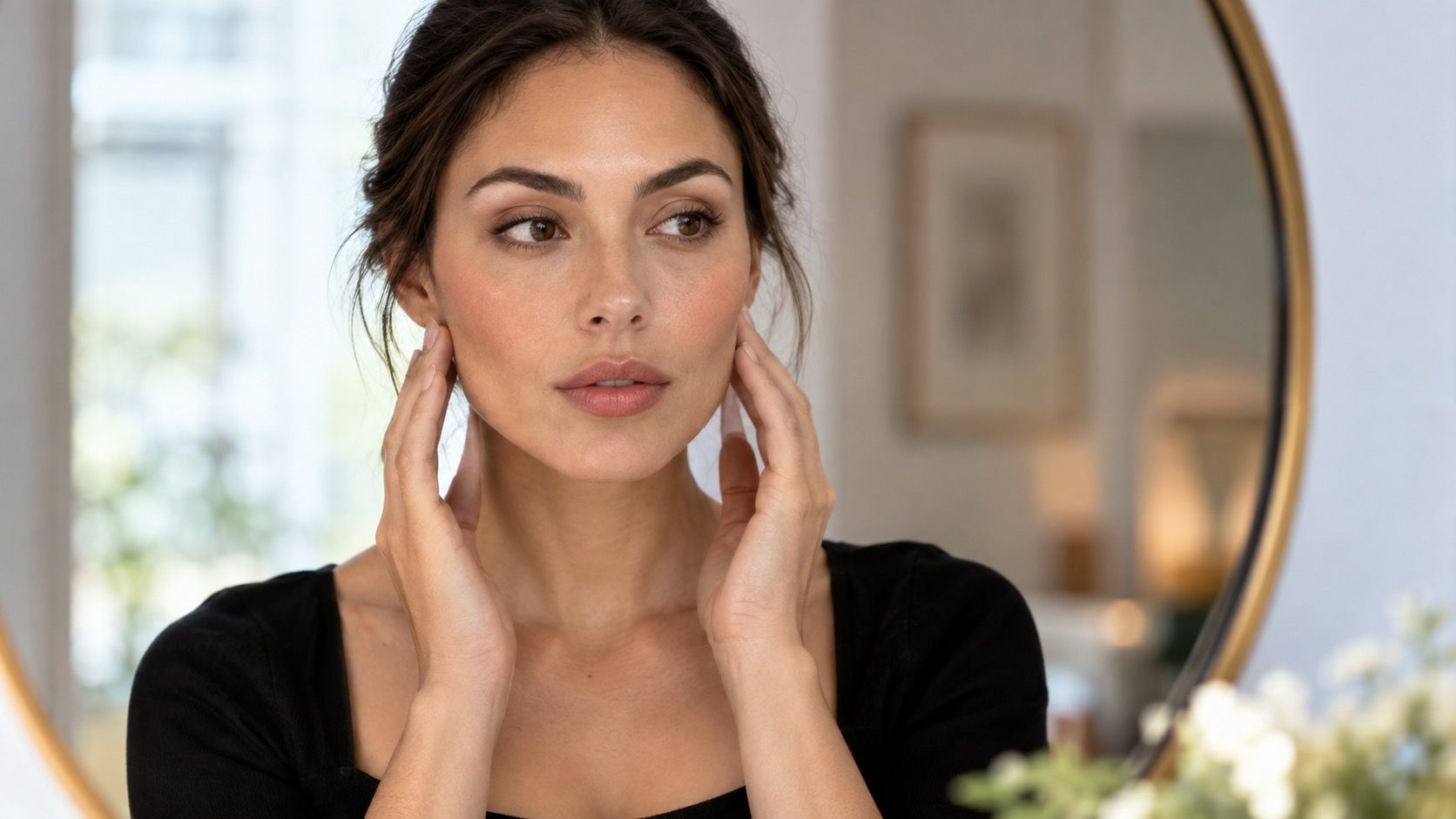
Start with hair pulled back and a relaxed, front-facing photograph. Keep the camera at eye level and step away from the lens. A close selfie can make cheeks look fuller and the jaw smaller, which pushes many faces toward a false round reading. Soft front light is kinder to comparison than side light, which can create dramatic shadows along the jaw.
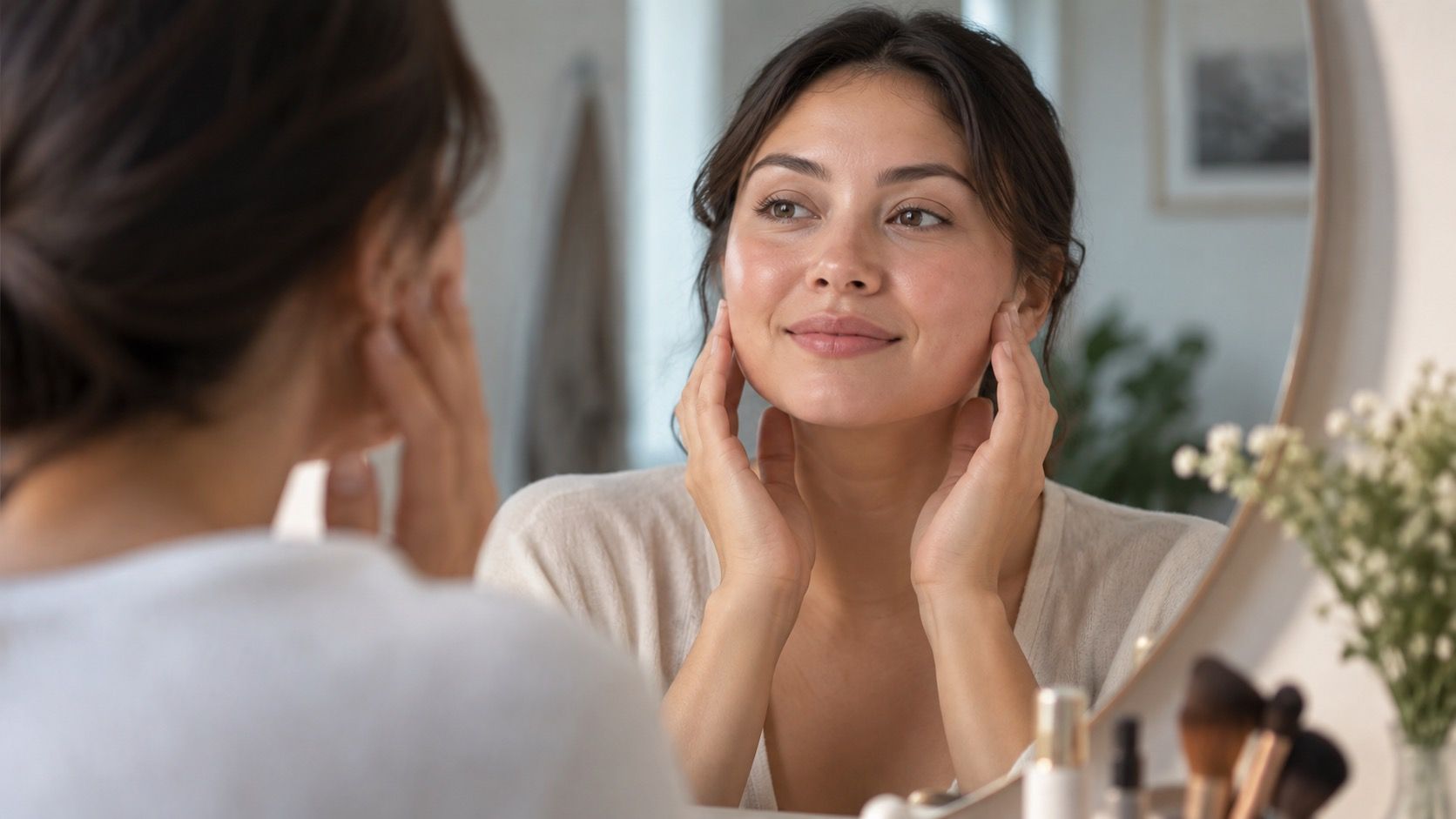
Compare the photograph with a mirror view on another day. If the same soft angles and near-equal width and length appear in both, the observation is likely sound. If a face looks round only in one close photo, change the camera distance before drawing a conclusion. The goal is to see facial proportions, not to identify the most flattering or least flattering angle.
Compare round with oval proportions
Round and oval face shapes are commonly mixed up because both can have smooth jawlines and soft cheeks. Oval faces are usually more visibly longer than wide. The sides may still curve, but the vertical line from hairline to chin has more presence. A round face keeps a more compact width-to-length relationship.
Try a simple comparison rather than guessing. Note the face length, then the widest point across the cheekbones or forehead. You do not need a mathematical threshold. If length clearly leads, oval may be a better starting description. If length and width feel close and the jaw remains soft, round characteristics are stronger. Mixed results are normal, especially when the chin is slightly tapered.
| Observation | Useful interpretation |
|---|---|
| Length is clearly greater than width | Compare oval or rectangle traits before choosing a label. |
| Cheekbones lead the horizontal widths | Check whether the jaw tapers softly or stays broad. |
| Jaw corners are visible | Look at overall length to separate square and rectangle proportions. |
| Two labels seem plausible | Keep the repeated traits instead of forcing a perfect category. |
Compare round with square proportions
Round and square faces can have similar overall width, but the jawline tells a different story. A square face has a more visible horizontal jaw and firmer corners near the ears. A round face softens that path: the jaw turns gradually toward the chin, and the lower face does not create a strong box-like edge.
Do not decide from the forehead alone. A broad forehead occurs in many face shapes. Follow the whole outline with hair away from the sides. If the cheekbones, forehead, and jaw are broadly similar but the angles are soft, round may fit. If the same widths are paired with a pronounced jaw corner and a squarer chin, square traits may be more important.
Choose styles based on preference, not correction
Advice for a round face shape often uses the language of “slimming” or “lengthening.” You do not need to fix a proportion to choose a hairstyle or frame. If you want a more vertical visual line, you might try height at the crown, longer layers, or a frame with a little upward movement. If you like a softer, compact look, rounded frames and fuller side volume can be just as intentional.
Fit is more decisive than theory. Glasses should rest comfortably, show your brows in a way you like, and suit your prescription. A haircut should work with your texture, schedule, and willingness to style it. Face shape can give you vocabulary for testing options; it should not make the decision for you.
Keep the result flexible
Your face can look more or less round depending on hairstyle, expression, and weight distribution, and none of those changes erase your underlying proportions. A side part may reveal more forehead; a high collar may frame the jaw differently; a smile may lift the cheeks. Notice these effects without treating them as errors.
A practical summary might be: “my face is close in width and length, with soft cheeks and a rounded jaw.” That is enough to recognize round face characteristics and to explore style ideas. The label is useful only as long as it helps you notice what you actually see.
Check the features that stay true from day to day
The best round face check is repeated under ordinary conditions. Look once with hair secured back, once in your usual hairstyle, and once in an eye-level photo. If the face remains close in width and length and the lower outline stays curved, the round reading is probably useful. If a longer vertical line becomes obvious as soon as the lens moves farther away, oval traits may matter more than the first selfie suggested.
Use that answer gently. The same person can choose a high-volume haircut one week and a rounded bob the next because style is allowed to change. Face shape is a way to describe the canvas, not a rule about which looks are permitted. Notice too how the forehead participates in the outline. A round face does not need a narrow forehead; the useful question is whether its width, the cheekbones, and the gently curved jaw create a compact overall impression.