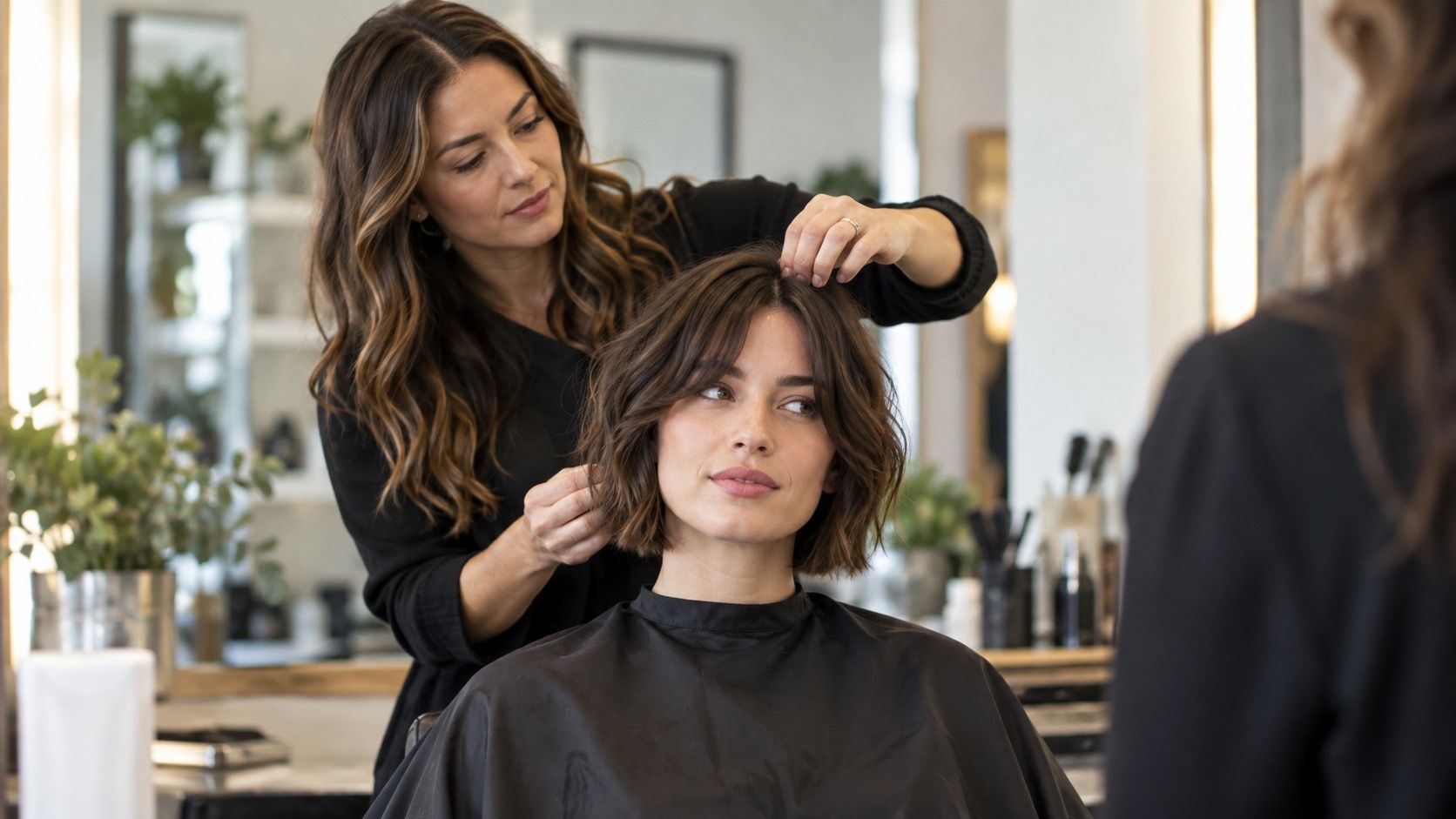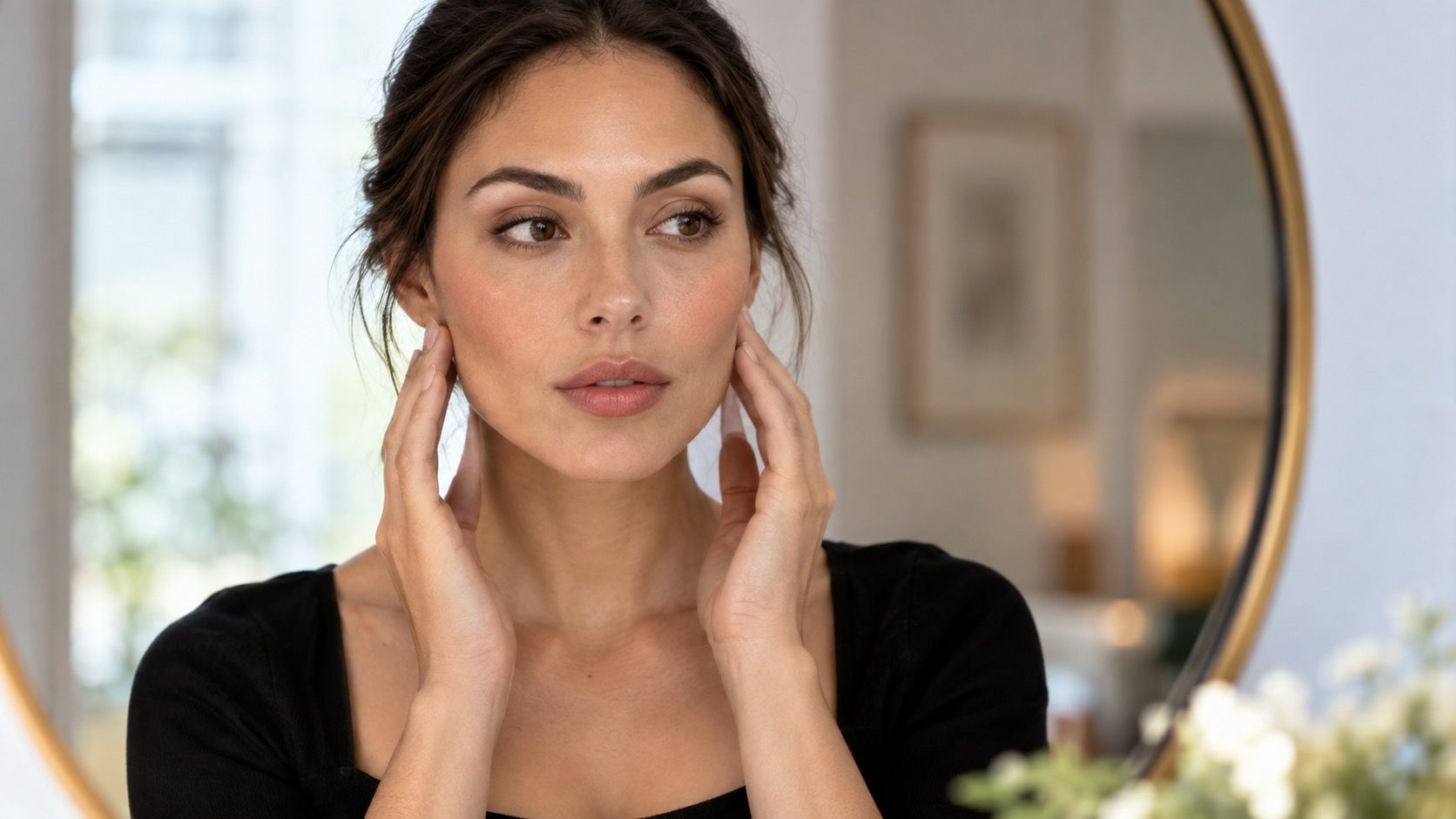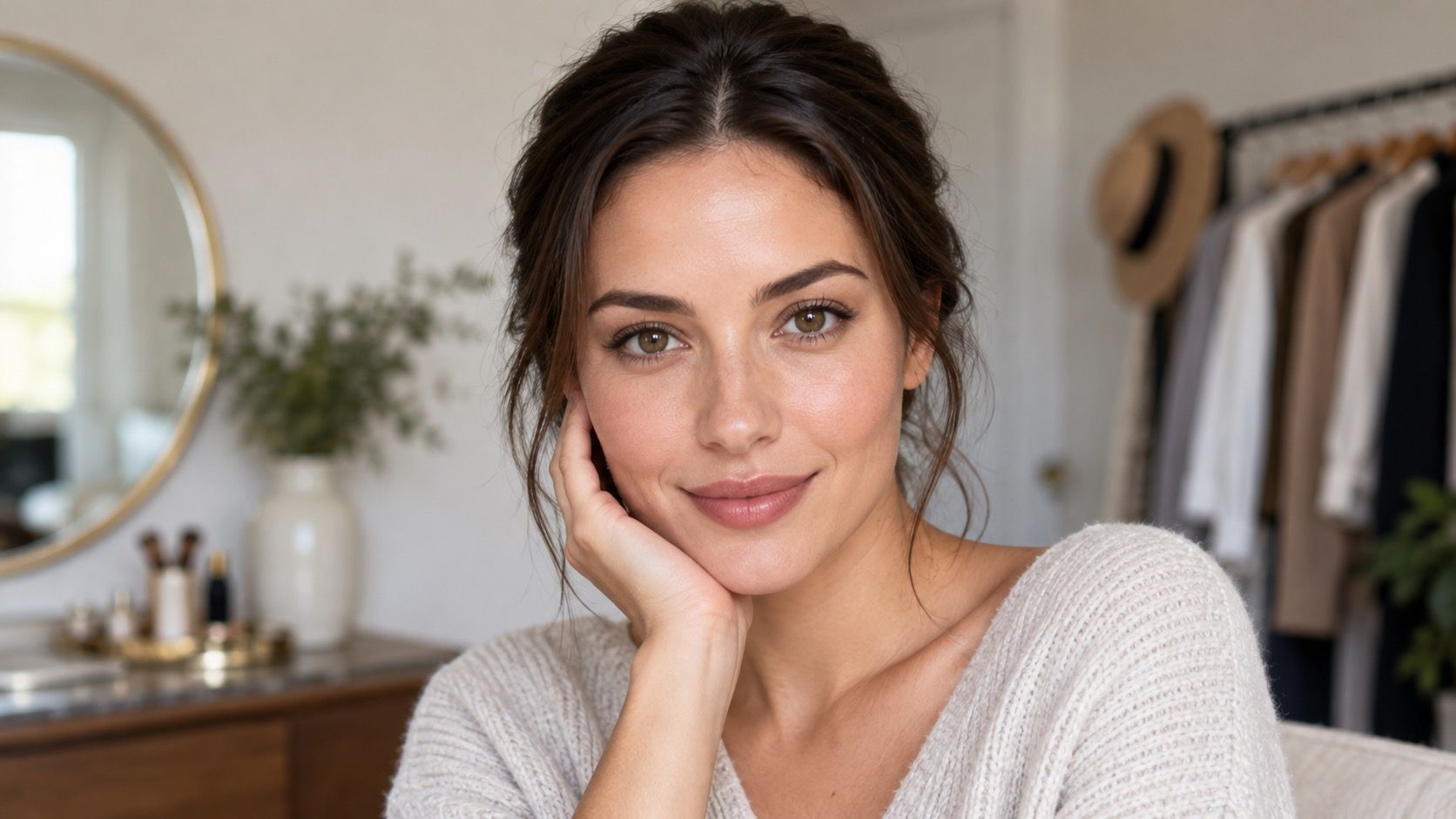
An oval face shape is usually a little longer than it is wide, with cheekbones that are similar to or slightly wider than the forehead and a jawline that narrows without a hard corner. The chin may be rounded or gently pointed. The word “oval” describes the overall flow of the outline; it does not mean every feature must be soft or perfectly symmetrical.
What an oval face shape usually means
It is common to recognize an oval face in one photo and question it in another. Hair, camera distance, and expression change the apparent outline. Look for the proportion that stays stable when the hair is pulled back and the face is relaxed. A clear length-to-width difference and a smooth transition from cheekbones to jaw are usually more informative than the fullness of the cheeks.
An oval face shape is usually a little longer than it is wide, with cheekbones that are similar to or slightly wider than the forehead and a jawline that narrows without a hard corner. The chin may be rounded or gently pointed. The word “oval” describes the overall flow of the outline; it does not mean every feature must be soft or perfectly symmetrical.
Check the outline in a reliable view
Use a mirror in front-facing daylight or a photograph taken at eye level from a modest distance. Keep your head level and leave the jaw unclenched. Start at the forehead, move outward to the cheekbones, then follow the line down to the chin. On an oval face, the sides often curve inward gradually rather than widening sharply at one point.
Do not judge the shape through a dramatic hairstyle. Thick curls, a wide fringe, and a deep side part can create a different visual frame, which may be exactly what you want stylistically, but they should not decide the label. For the comparison, expose the hairline and ears. Then return to your normal styling when deciding what looks good to you.
Separate oval from oblong and rectangle
Oval and oblong face shapes are often confused because both are longer than wide. The difference is usually in the side lines and lower face. Oblong or rectangle proportions tend to have more consistent width from forehead through jaw, while an oval face narrows more gently toward a softer chin. A visibly longer lower third can also make a face read oblong even when the cheekbones are rounded.
Measure if the mirror feels ambiguous. Compare face length with the widest horizontal point, then compare forehead, cheekbones, and jaw. Similar widths plus a more angular jaw support rectangle more than oval. A tapered jaw and cheekbones that provide the broadest point support oval proportions. Do not rely on one measurement or one profile photo.
| Observation | Useful interpretation |
|---|---|
| Length is clearly greater than width | Compare oval or rectangle traits before choosing a label. |
| Cheekbones lead the horizontal widths | Check whether the jaw tapers softly or stays broad. |
| Jaw corners are visible | Look at overall length to separate square and rectangle proportions. |
| Two labels seem plausible | Keep the repeated traits instead of forcing a perfect category. |
Separate oval from heart-shaped proportions
Oval and heart-shaped faces can share a soft jaw and a tapered chin. The difference often begins at the forehead. A heart-shaped face usually has a more obvious broadness across the upper face and a narrower jaw, sometimes with a more pronounced point at the chin. An oval face tends to have a more even, continuous balance between forehead and cheekbones.
Hairline details can complicate this check. A widow’s peak can make an otherwise oval outline look heart-like, while bangs can hide a wide forehead. Look at width beneath the hairline, not only at its shape. If your forehead is only slightly wider and the rest of the face flows evenly, a mixed oval-heart description may be more honest than choosing one camp.
Use oval traits when choosing a style
People often hear that an oval face can wear everything. That is a pleasant simplification, not useful advice. A better starting point is to decide what you want from a particular look. If you enjoy your cheekbones, a tucked-behind-ear style or a frame that does not cover them may highlight them. If you prefer a stronger visual width, volume at the sides or a bolder frame can create it.
Glasses, haircuts, and makeup work with more than face shape. Bridge fit, prescription, hair texture, maintenance, skin sensitivity, and personal taste are real constraints. Try a shape in a good mirror before buying it. A face-shape chart can suggest options, but comfort and the way you feel in the result are better judges.
Allow for change and asymmetry
A face is not a fixed diagram. Makeup, facial expression, body changes, and aging can alter how the outline reads without making your earlier observation wrong. One side of the jaw may be fuller or more angular than the other, and that is ordinary. Use the overall pattern rather than trying to average every millimeter.
The most useful oval face description is specific: perhaps your face is longer than wide, your cheekbones are softly prominent, and your jaw tapers. Those traits provide a steady reference when you experiment. They do not require you to balance, soften, or correct anything.
A practical way to check your conclusion
If you are still asking “is my face oval?”, make three simple notes after looking at a straight photo: where the widest point sits, whether length clearly exceeds width, and how the jaw meets the chin. An oval conclusion is strongest when cheekbones sit at or near the widest point, the lower face narrows gradually, and there is no strong square corner. That is more reliable than comparing your face to a celebrity photograph with different lighting, makeup, and camera distance.
Keep the notes even if you decide the answer is mixed. “Oval length with a broader forehead” is a useful description when choosing a parting or a frame. It gives you options without pretending that every person belongs to one clean illustration.