Oblong and oval face shapes are confused for a sensible reason: both can look longer than they are wide, both can have a softly rounded jaw, and both can change character with a fringe or a camera angle. The useful distinction is not whether your face seems “long.” It is whether length dominates the whole outline, or whether width and curves keep that length in balance.
Why the labels overlap in ordinary life
An oval face shape is usually described as gently longer than wide, with the widest point around the cheekbones and a jaw that narrows without becoming sharp. An oblong face shape, sometimes called long or rectangular, also has more length than width. The difference is that the vertical line is more persistent: forehead, cheek area, and lower face all contribute to a longer impression.
That sounds tidy on paper, then becomes messy in a bathroom mirror. A high hairline can make an oval face look oblong. Long hair placed flat against the cheeks can make either shape look narrower. Conversely, a chin-length bob with side volume can make an oblong face appear close to oval. The label should describe your bare facial proportions, not the effect of your current haircut.
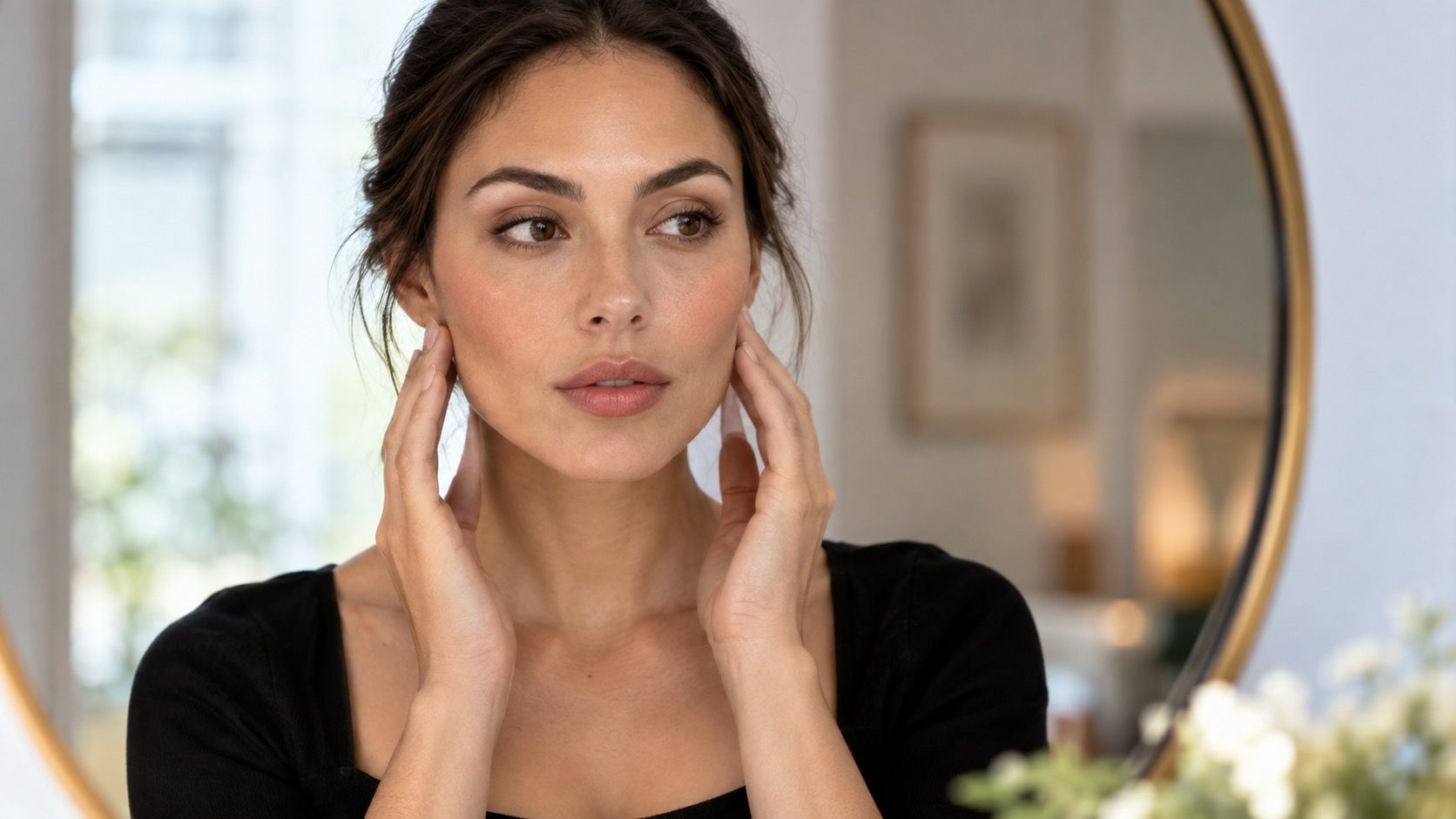
Begin with a neutral, straight-on photograph. Use the rear camera if you can, stand far enough away to avoid wide-angle stretching, and keep the lens around eye height. Selfies taken at arm's length often lengthen the centre of the face and compress the sides. They are fine for messaging friends, but poor evidence for deciding whether you have an oblong face shape.
Then compare several images rather than searching for certainty in one. If the same long vertical pattern appears with your hair tied back, in a passport-style photo, and in a casual picture, it is worth noting. If it appears only when you lift your chin or use a front camera, the phone is probably doing more classification than your bone structure.
Compare vertical length in three parts
The simplest visual check is to divide the face into upper, middle, and lower thirds: hairline to brow area, brow area to base of the nose, and base of the nose to chin. Nobody needs perfectly equal thirds; faces are not architecture. You are looking for whether one or more vertical sections seem extended enough to make the full face read as long.
On an oval face, the length tends to feel contained by curved cheekbones and a tapered jaw. The forehead may be high, but the face does not look stretched from top to bottom. On an oblong face, you may notice a longer forehead, a longer chin area, or both. The cheeks often look relatively straight at the sides rather than creating a broad central curve.
Use a ruler only if it stops you guessing. Measure from the centre hairline to the chin, then compare with cheekbone width at its widest point. The ratio is less important than the pattern you can see. A number cannot tell you whether your cheekbones curve outward or whether your jaw carries width; those details are why two people with similar measurements can look quite different.
Lighting deserves some suspicion here. An overhead bathroom light throws a shadow beneath the brow and chin, making the vertical distance feel more pronounced. Window light from the front is kinder for analysis. If you have ever looked “very oblong” at 7 a.m. and entirely oval at lunch, the difference may be a ceiling bulb rather than an overnight facial transformation.
Read where the width lives
Width distribution is often the more reliable clue. An oval face usually has a visible widest point at the cheekbones, with the forehead a little narrower or similar and the jaw tapering below. This central fullness offsets the length. An oblong face can have cheekbones too, but the sides tend to feel more parallel from temple to jaw, so width is not concentrated in one rounded middle section.
Try covering the lower face in a photo and look at the forehead and cheeks. Do they form a broad, softly curved centre? That leans oval. Now cover the cheeks and look at the side lines from temple toward jaw. If they continue down in relatively straight lines, oblong may be the more useful description. This is a visual exercise, not a pass-fail test.
Pay attention to hairstyle before making that call. Volume at the temples widens the top; waves beside the cheeks widen the middle; sleek hair behind the ears reveals the true side line. A single style can therefore make you seem to switch categories. The stable observation is what remains when the hair is pulled back gently and the face is relaxed.
| Feature to compare | Often reads more oval | Often reads more oblong |
|---|---|---|
| Overall length | Longer than wide, but visually contained | Length is the first feature you notice |
| Cheek area | Clear central curve or widest point | Width feels more even from top to bottom |
| Side outline | Gently tapers toward the chin | More vertical or parallel before the jaw |
| Styling response | Many proportions already feel balanced | Side width or a fringe may reduce vertical emphasis |
Do not confuse oblong with rectangle
Oblong and rectangle are also used as if they mean the same thing, but rectangle usually implies a stronger jawline and more angular corners. An oblong face can be long with a softly rounded chin, curved cheeks, and no obvious square jaw. The common thread is length, not sharpness.
Look specifically at the jaw corners. If the jaw stays broad and angular, rectangle or square-oblong may describe the face better. If it narrows smoothly and the chin is rounded or gently tapered, oblong is more likely. This distinction matters if you use style references: a blunt jaw-length cut can behave very differently on a long soft jaw than on a long angular one.
Forehead shape is another small clue, not a deciding one. A rectangular face may look fairly consistent in width across forehead, cheeks, and jaw. An oblong face can have a slightly wider forehead or cheek area, provided the overall vertical proportion still dominates. Calling every long face “rectangle” erases that difference.
There is nothing wrong with a mixed description. “Long oval with a defined jaw” may be closer to the truth than either label alone. It gives you a better starting point for hair than borrowing advice meant for a sharply square face just because both faces happen to be longer than wide.
Make haircut decisions from the feature you want to change
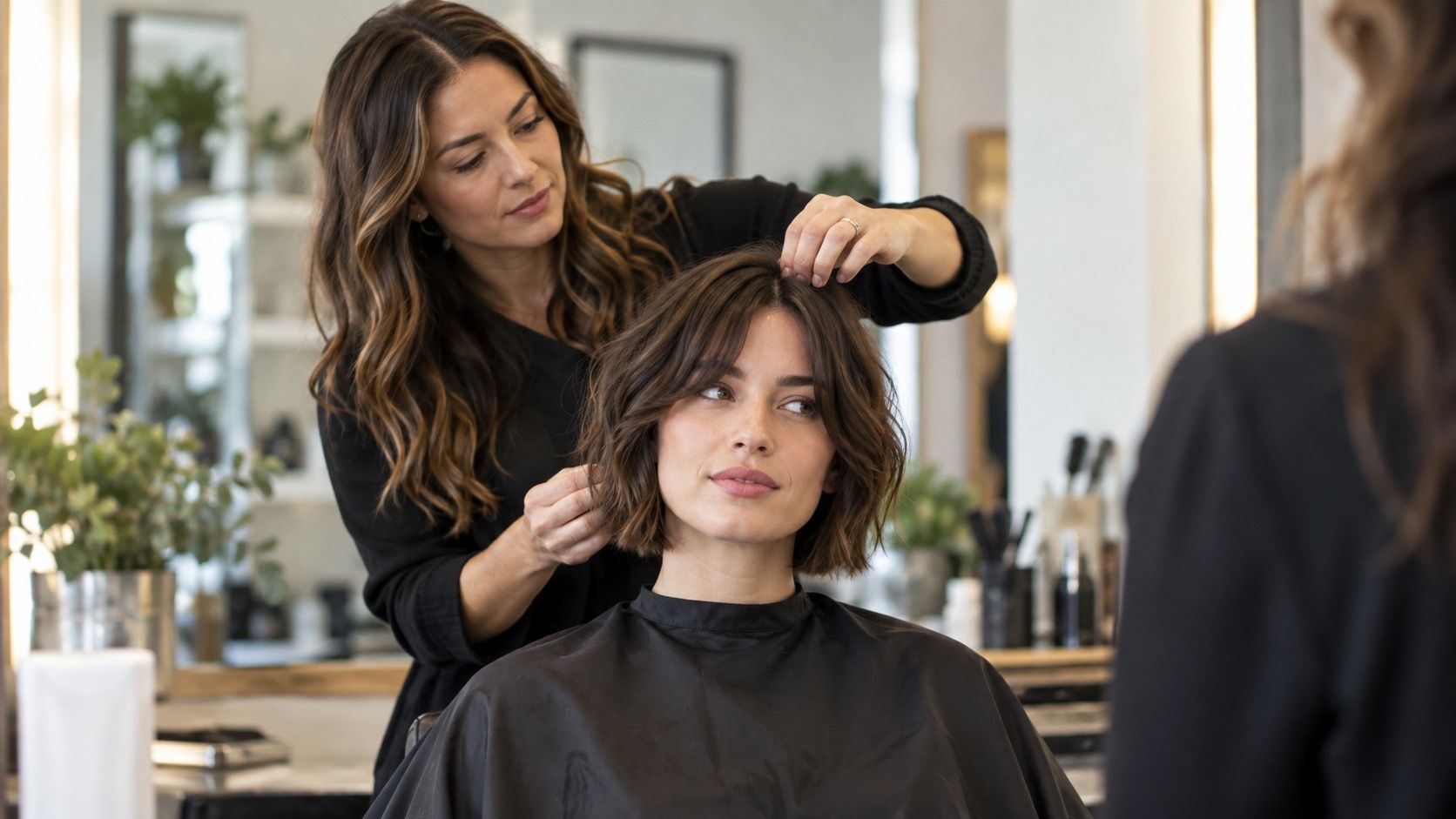
When an oblong face feels longer than you would like, the most effective haircut choices usually add width somewhere between the temples and jaw rather than piling height on top. A side-swept fringe, curtain fringe, textured bob, or layers that begin around the cheekbones can interrupt a long vertical line. The exact cut depends on hair density, curl pattern, maintenance tolerance, and whether you enjoy styling it on a weekday morning.
For an oval face shape, the usual claim that “everything works” is too lazy to be helpful. Many cuts can work because the proportions are flexible, but hair texture still decides the result. A very blunt, heavy fringe may shorten the face more than you want; flat, long hair may conceal the cheekbone curve that makes an oval face read balanced. Choose based on the mood and effort you want, not because a chart granted permission.
Parting changes the picture fast. A centred part can lengthen the visual line, particularly with straight hair hanging close to the cheeks. A soft off-centre part introduces diagonal movement. That does not mean one is good and the other is bad. It means a reference photo should show a similar hair texture, density, and parting if you want to predict its effect on your own face.
Bring two or three reference images to a stylist and say what you want to see less or more of: “I want width near my cheekbones,” or “I do not want extra height at the crown.” That practical language is better than announcing a face-shape label and hoping it contains every relevant detail.
Use photos consistently before settling on a label
Take a small set of comparison photos on the same day: hair pulled away from the face, neutral expression, eye-level lens, and even front light. Add one side-angle photo only to understand the forehead and chin; do not use it to classify the front outline. Repeating the setup removes most of the noise that makes online face-shape tools disagree.
When reviewing the images, ask three questions. Does the face look notably longer than wide? Is there a clear widest point through the cheekbones, or are the sides fairly even? Does the jaw soften the overall outline or keep it geometric? Your answers may land on oval, oblong, or a blend. All three are usable outcomes.
It is worth resisting the urge to chase an exact ratio. Face shape categories were invented as shorthand for visual balance, not as medical measurements. A hairdresser choosing a fringe, an optician helping with frame width, and a makeup artist placing blush will all get more value from the features you notice than from a precise but fragile label.
Oblong versus oval face shape becomes clear when you stop asking which label is more flattering. Look at length, where the width sits, and how the jaw finishes the outline. Then use that information as a small part of a styling decision, alongside your hair, glasses, preferences, and the practical reality of how much time you want to spend in front of the mirror.