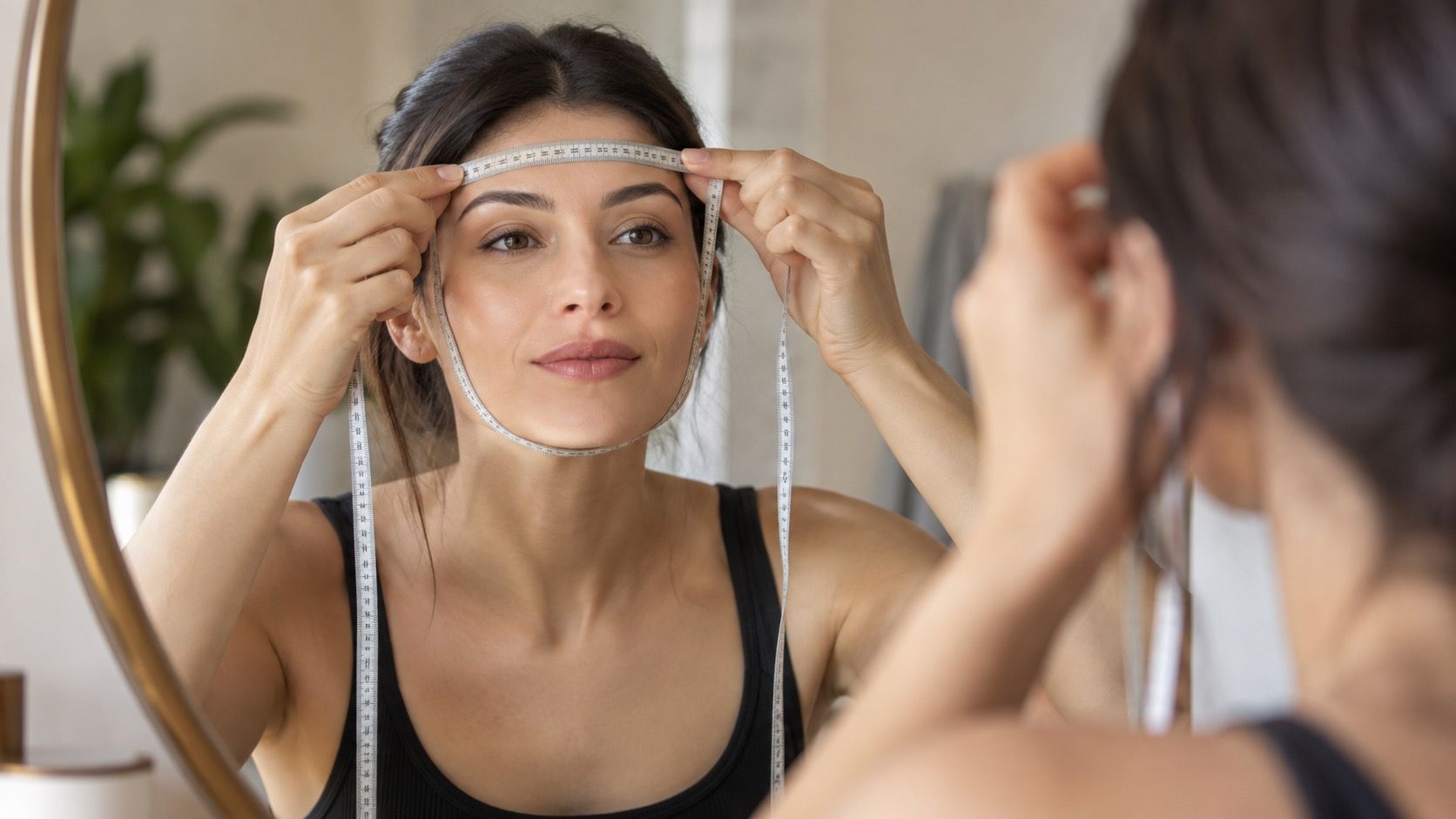
The quickest way to answer “what is my face shape?” is to stop looking for one dramatic feature. Face shape is the relationship between the forehead, cheekbones, jawline and overall face length. Pull hair away from the outline, stand in soft daylight, and look straight ahead with your jaw relaxed. A front-facing photo taken at eye level is useful because it lets you compare the left and right sides without constantly moving your head. Avoid a phone held very close: a wide-angle lens can enlarge the center of the face and make the cheeks or jaw look unlike they do in a mirror.
Start with an honest view of your outline
Start with the broadest horizontal area. For some people it is the forehead, for others the cheekbones, and for others the jaw. Then notice whether the face is clearly longer than it is wide, nearly as wide as it is long, or somewhere between. Finally look at the path from cheekbone to chin: does it taper, curve gently, or run in a firmer line? Those three observations are more dependable than an online face shape test that asks for a single answer.
The quickest way to answer “what is my face shape?” is to stop looking for one dramatic feature. Face shape is the relationship between the forehead, cheekbones, jawline and overall face length. Pull hair away from the outline, stand in soft daylight, and look straight ahead with your jaw relaxed. A front-facing photo taken at eye level is useful because it lets you compare the left and right sides without constantly moving your head. Avoid a phone held very close: a wide-angle lens can enlarge the center of the face and make the cheeks or jaw look unlike they do in a mirror.
Set up a photo that does not distort the result
Use the rear camera if someone can take the picture, or place the phone at eye height and step back before using a timer. Keep the lens roughly an arm and a half away. Window light from the front is preferable to a ceiling light, which can throw a heavy shadow under the brow and jaw. A neutral expression matters too. A wide smile lifts the cheeks; a clenched jaw makes the lower face look more angular.
Take two images rather than trusting one. In the first, tuck hair behind both ears or use a soft headband. In the second, leave your usual parting in place. The first image reveals proportions; the second helps when you later choose glasses, a fringe, earrings, or a haircut. Do not trace an outline around loose hair and call it your face shape. Hair is part of a style decision, not part of the bone-and-soft-tissue comparison.
Compare width and length before naming a shape
If you want to measure face shape, a flexible tape can help, though the numbers do not need to be perfect. Measure from the center of the hairline to the bottom of the chin, then compare the widest forehead, cheekbone, and jaw spans. Measure across the face in a straight line rather than following the curve of the skin. A difference of a few millimeters is usually meaningless; the pattern is what counts.
A long face with similar widths at forehead, cheeks, and jaw may lean rectangle. A face where cheekbones are the widest point and the jaw narrows softly may read oval or round depending on length. A broad forehead with a narrower chin can suggest heart-shaped proportions. These are descriptions, not diagnoses. Lighting, weight changes, and a natural asymmetry can all make a face sit between familiar labels.
| Observation | Useful interpretation |
|---|---|
| Length is clearly greater than width | Compare oval or rectangle traits before choosing a label. |
| Cheekbones lead the horizontal widths | Check whether the jaw tapers softly or stays broad. |
| Jaw corners are visible | Look at overall length to separate square and rectangle proportions. |
| Two labels seem plausible | Keep the repeated traits instead of forcing a perfect category. |
Read the forehead, cheekbones, jawline, and chin together
The forehead is easy to overestimate when the hairline is high or uneven, so look at its width rather than its height. Cheekbones are best judged across their outermost points, not at the fullest part of a smile. For the jawline, ask whether the corners beneath the ears are visibly broad, whether the line narrows steadily, and whether the chin is rounded, pointed, or more squared off.
No single feature settles the question. A pointed chin does not automatically create a heart face if the forehead and jaw have similar widths. Full cheeks do not automatically create a round face if the face is noticeably longer and the jaw tapers. The useful face shape test is a comparison of recurring proportions in a mirror and an ordinary photograph, not a hunt for a perfect silhouette.
Make room for mixed features
Many people have mixed features. You might have an oval face length, a softly squared jaw, and cheekbones that are slightly wider than the forehead. That does not mean the observation failed. It simply means that a single label will leave something out. Write down two or three traits that remain true across photos instead: “longer than wide,” “soft jaw,” or “widest at cheekbones.”
This approach is especially helpful when style charts disagree. Use the chart as an idea generator, then test frames or hairstyles in real life. A pair of glasses that fits your bridge and feels comfortable will matter more than whether its corners supposedly oppose your face shape. The same is true of a blunt fringe, a center part, or contour placement.
Use the result as a styling reference, not a rule
Once you know how to find your face shape, keep the result small and practical. A face that looks longer than wide may make you curious about width at the sides of a haircut. A strong jawline may influence whether you prefer rounded or angular frames. None of that requires correction. The point is to choose deliberately rather than obey a diagram.
Repeat the check after a few days if the answer feels uncertain. Compare the same type of photograph, not a close selfie against a distant holiday photo. The most useful conclusion is often a sentence rather than a label: “my cheekbones are the widest point and my chin is soft.” That is enough information to make thoughtful choices.